

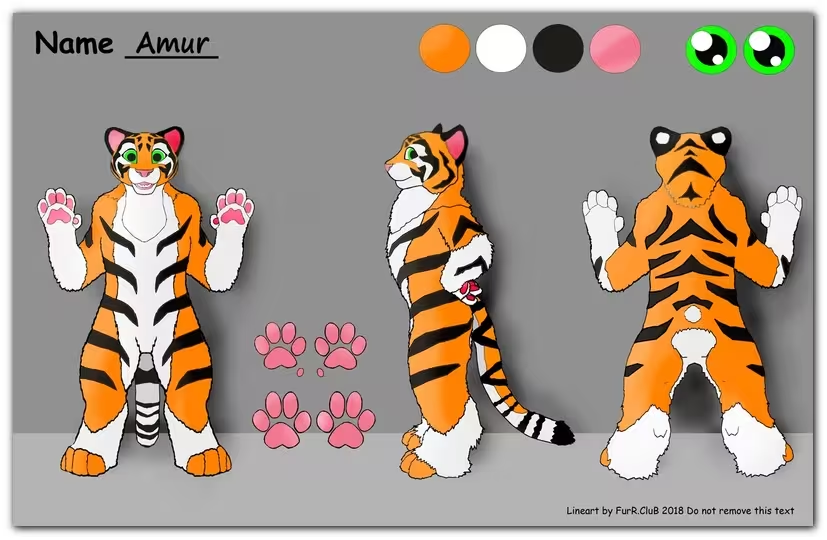
Tiger Amur
 View photo session →
The head for Tiger
The head's shape was developed specifically for this project. Below is the method of obtaining patterns and the end result. The mask was glued from thin polyethylene foam and a metal frame along the edges. The mask has a lighter weight compared to constructions made of plastic or foam rubber. The result perfectly preserves its shape, which can be slightly corrected on an already fully assembled mask. The jaw is not only openable, but completely removable — this facilitates head drying. When you start mounting a metal frame into the "crust" of the mask, places subject to the greatest load appear, and polyethylene foam may break there. These places may be pre-strengthened by gluing pieces of fleece — it will also be convenient for sewing the wire of the frame to these places, which greatly simplifies gluing wire along the edge. The diagram shows the pattern for this head. The pattern was already adjusted for a better end result (above in the photos is work with uncorrected patterns). The yellow dotted line is the line of the head's symmetry: accordingly, the half-mask is shown on the diagram. The red dotted line relates to parts of the ear and places for the ear's gluing.
Pasting the head with fur
Before starting to make the fur patterns for the head, it is advisable to check the color scheme of the character by drawing it on top of the photo of the mask. To make the fur patterns, you need to cover the mask with adhesive tape (several layers) and draw the desired color scheme. After transferring these patterns to fur, it must be sewn as a "fur skin". To get a neat edge of fur at the edges of the eyes and mouth, you need to create an invisible "torn fabric" effect on the artificial fur — in these places the fur is bent and embroidered with thread. To make the mask look neater, you need to shave the fur on the muzzle to a short length. An example of before and after is shown in the photo.
Nose
So the nose does not get lost in the fur, it must be raised above the mask material. For this, it is pasted with an additional layer of material. The nose turns out to be soft. And being covered with fleece, the nose will be safe if you accidentally bump someone with it (which may happen quite often). The strip of black fleece around the nose is initially sewn to the fur of the mask, achieving accuracy this way. The edging has a varied width along the edge of the nose for a more aesthetic appearance (the first option, a simple straight edging, spoiled the appearance).
Ears
The design of the inner part of the ears includes a fleece coating. The pattern for this part is obtained by gluing the ear with adhesive tape. The transition from the ears to the head is also pasted with strips of fleece — this is necessary both for the strength of these places, and for the further convenience of gluing the fur pattern parts from the ear to the head. To carefully attach fur to the ear of the mask, you can follow this method: 1. The ear's fur must be turned inside out. 2. Gluing must begin from the front part of the ear, from the ground. The thickenings of the ear are a good guide to see where the borders of fur should be. With this method, the hot melt gun will not mess up the fur and other visible parts of the mask. 3. When the fur preparation is glued along the front edge of the ear, it is necessary to turn it back to its normal position and stretch the fur to the back of the ear; continue gluing along the bottom edge of the ear. The ears hide large openings in the mask for additional ventilation. The ventilation holes will be masked by fur, so they can be large in size.
Pasting fleece inside the head
The inside of the mask must look aesthetically pleasing as well as the outside, and for that we cover it with fleece inside. This is done as follows: 1. Strips of fleece about 5 cm wide cover all the edges of the mask, including the eyes and jaw. 2. To get patterns for the inner part of the head, cover it with adhesive tape. 3. Flatten the resulting patterns to a plane and transfer them to the fleece, sew and glue them at once to a large area inside the mask. 4. Next, the eyes must be made and installed. Then it is necessary to get new patterns to cover the bases of the eyes with fleece from within the mask, again using adhesive tape. 5. The base of the eyes is pasted with fleece. The second photo shows the linings: 1. Two pads behind the ears of the performer — this creates space for free movement of the jaws of the mask. 2. One lining on the forehead to create free space in front of the performer's eyes. 3. There is another adjustable lining under the chin. It is needed to adjust the responsiveness of the jaw of the mask to the movements of the performer's mouth. All pads are removable and can be shifted to some degree for a better fit of the mask. At the end of the mask's fitting, another lining was added on the crown (no photo unfortunately) — it also improved airflow from the holes near the ears to the mouth of the mask, improving ventilation.
The eyes
The eyes are made with a tracking effect, i.e. they are recessed into the interior of the mask. The symmetry, position and shape of the eyelids are set and preserved by a wire frame that continues on the cheeks and adjusts the width of the upper half of the mask (while forming the convex cheeks below). The frame for the eyes is made from 3 mm white plastic. The form of the eye boxes has a cavity for the nose of the performer. The iris and pupil are painted with waterproof acrylic over banner grid. Inside the head, the eye frame is covered with black fleece (see about it above).
Making the aprons
Just like when covering the head with fur, the manufacture of aprons begins with obtaining their patterns. To do this, you need to cover the places of future aprons with adhesive tape (this is shown in the photo). In our design, there are two aprons: front and rear. This allows you to avoid a zipper on the back of the head, which makes it easier to dress and use the mask. The shape of the neck is formed by elastic bands on the back apron. The back apron covers the neck and fastens on a reliable, large button under the front apron. The front apron is completely removed together with the jaw. This allows free access to the inside of the fully assembled mask (for example, for quick drying, cleaning or servicing the removable fan). The rear apron has a buckle at the front, which hides under the front apron. This design of the apron simplifies dressing the mask and removes such an inconvenient element as a zipper in a visible place (on the back of the head).
The Teeth
Teeth are made of white fleece according to the pattern shown in the photo. Individual teeth are obtained by covering the "fleece tube" with a strong nylon thread. The jaw moves by means of textile elastic bands, which are fastened inside the mask on Velcro. The area for Velcro was increased, allowing them to be fastened with different tension. This allows adjusting comfortable and easy movement of the jaw. The jaw is completely removable. Below, on the second photo, you can see the removable tongues (there are several in the kit plus a soft lining under the chin). The lining is held on textile Velcro and can be shifted in a wide range to adjust the ease of opening the jaw. For example, using this pad, you can set a permanently open mouth to ensure good ventilation.
Ventilation of the head
For this mask, two fans were made: 40 and 80 mm. But the small fan turned out to be very inefficient even at full speed (at 12 volts). Still, the bigger the fan, the better. So we recommend making the largest fan for masks, one that is guaranteed to cover the entire mouth opening of the mask. For example, a large fan allows you to maintain good performance and silence when powered by a USB power bank (the fan will run at half of the possible revolutions).
Paws
Gloves (fur paws) are made with convex pads. The basis for the feetpaws is a frame made of foam rubber. Thanks to this foam shell, our feetpaws are lightweight and suitable for legs of almost any size. Since foam rubber is uncomfortable in its pure form and is not very resistant to tearing, the foam was enclosed and strengthened by a fleece sock that can be turned out for drying or quick washing. Two pairs of feetpaws were made: with cushions on the sole for photo shoots, and with a rubber sole for the street. The rubber soles were glued to the furs and foam frame, and stitched along the edge with strong nylon threads.
The overall
The overalls are made universal in size and with a low waist, which allows the performer to be very tall. The versatility of the dimensions is ensured by a large size in the width of the overall over the entire height. This width is turned into a tight-fitting shape thanks to textile elastic bands which are sewn onto the overalls. The tiger character has symmetrical stripes. To draw them on the overalls, you can follow this method: 1. Dress the future tiger's overall on a fabric mannequin. 2. Draw stripes on one half of the overall, just for their approximate position. 3. Next, cover the contours of the future stripes with adhesive tape, which allows you to move the boundaries of the stripes relative to each other to find their best mutual position. 4. Describe the selected contour of stripes on the current half of the overall with a clearly visible line. 5. Seal the inner space of the tiger's stripes with adhesive tape. 6. Unstick the future patterns of the tiger's stripes and cut them along the contour, i.e. along the adhesive tape. 7. Transfer the patterns of each stripe symmetrically to the second half of the tiger's overall.
Exoskeleton's linings
The form of the character's body is set by the exoskeleton's linings (in addition to the torso of the performer :)). The linings are removable: inside the overalls there is textile Velcro. This means linings can be removed and cleaned separately from the overall. Exoskeleton linings are sewn from a highly stretchable fabric and filled with synthetic padding. Compared to the usual version with foam rubber pads, our linings are very lightweight. Also, unlike foam rubber, these pads are perfectly compressed for transportation.
Stretchable fursuit body
The photo shows the tightening of the overall through textile elastic bands: several zones along the overalls can be stretched to twice their size. This is done so the fursuit sits "like a glove" in a wide range of possible performer sizes. It also reduces the risk of tearing the overall when doing such simple actions as deep squatting.
Tail
The tail is made demountable: it consists of a frame and a removable fur cover. This is comfortable, since in most cases it is enough to wash only the fur part of the tail. This design speeds up the drying process after washing, because the synthetic padding filler would dry much longer if you cleaned the tail entirely. Fastening the tail to the belt is provided by loops of a strong nylon cord, which are sewn to the frame of the tail. This is a very sturdy construction, as the tail frame is sewn from a more stretchable and durable fabric than artificial fur. In the overalls, a small sleeve for the tail is provided to mask and ensure the integrity of the transition line from the tail to the body.
 Twitter — SpaceAlienFox
 Facebook — SpaceAlienFox
 Instagram — FurR.CluB
 Boosty — FurR.CluB
 FurAffinity — FurR.CluB