

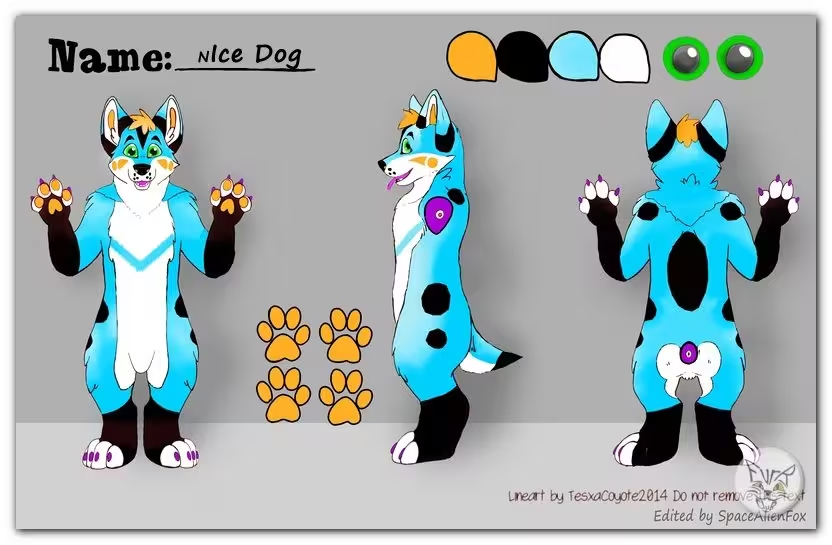
nIce Dog
 View photo session →
The head
A new form for the head was developed. On the scan the white dotted line is the line of symmetry of the head, the green part is the ear and the place for its gluing. The workpiece is glued from foam polyethylene, therefore it has a light weight and perfectly preserves and restores the shape. On the edge of the mouth, lips, with the transition to the cheeks and behind the head, a frame of steel wire is glued. The jaw is made openable and removable.
The nose
The nose was raised by the same material from which the head is made, but of a different thickness — a thinner one. The patterns for the nose were obtained by pasting with adhesive tape, and sewn from fleece, which is glued over the nose blank.
The ears
The whole inner part and edges of the head were covered by fleece. All patterns for fleece were obtained by gluing the head inside with adhesive tape. Since according to the character's reference the ears inside have an orange color, they need to be pasted with the appropriate cloth. The pattern of fleece for this area is obtained by gluing the ear with adhesive tape. Inside the ear, large ventilation openings are made. Through these openings, the air will be sucked in by the fan installed in the jaws of the head. Since in our design the head of the suit is some distance from the head of the fursuiter, the flow of air from the ears to the mouth will be good enough. The transition from the ears to the head is also pasted with fleece for the convenience of gluing the fur in these places.
Pasting fleece inside the head
The whole inner part and edges of the head were covered by fleece. All patterns for fleece were obtained by gluing the head inside with adhesive tape.
The eyes
The eyes are made with the tracking effect. The eye skeleton is made of 3 mm plastic with a cavity for the nose of the fursuiter. The seams of the frame are bent and treated with white silicone so that they are as small as possible. A large iris and pupil are painted with waterproof acrylic on banner grid. The inner part of the base of the head, near the eyes, is covered with white fleece so that the eye remains white at large viewing angles. Inside the head, the eyes are covered with black fleece.
Checking and clarifying the color scheme
How will the fursuit's head look after pasting with fur? Sometimes the head blanks look "ugly", which causes the desire to be convinced beforehand whether the work is done in vain. We also want accuracy in the choice of the eye contour and freedom in the position of the spots. There is a way: don't be lazy and spend half an hour on layer-by-layer drawing of the fur.
Fur pasting for mask
The mask was pasted with adhesive tape in several layers. After, we delineated according to the chosen character color scheme and cut the fur patterns. The pieces of fur are sewn and form the skin of the mask. The edges of the fur near the eyes and mouth are bent and glued so that the "torn" tissue base of the artificial fur is not visible. The skin is glued to the mask. As well as for gluing fur over the mask, the manufacture of aprons begins with obtaining their patterns by pasting adhesive tape over the required space. In our design there are two aprons: front and rear. This allows you not to use a zipper (usually at the rear), which makes it easier to dress and use the mask while keeping the profile of the neck. The back apron covers the neck and is fastened to a reliable, large button under the front apron. Also, given that the jaw can be completely removed together with the front apron, this allows good access to the inside of the finished mask, for example for drying or servicing the removable fan.
The teeth
Teeth are made of white fleece according to the shown pattern. Individual teeth are manufactured by wrapping with a strong nylon thread.
Ventilation of the head
A large enough 80 mm fan is installed in the mouth of the mask. The large diameter of the fan allows maintaining good performance and relative quietness at its low speed (the fan runs at half of the possible revolutions from the USB power bank). The entire design of the fan is demountable, including side gaskets which prevent unnecessary flow of warm air back into the mask. By removing the fan, you can wash the head without damaging it. The mask design provides for a large ventilation gap between the head of the fursuiter and the mask: the air flows freely from the ears of the mask, along the sides of the fursuiter's head and exits through the jaws of the mask.
The paws
We chose a bright combination of the colors of the paw pads and the main tone of the character, so that he could attract attention in addition to the character of the fursuiter himself. The basis for the feetpaws is a frame made of foam rubber, so they are suitable for feet of almost any size. For more comfort inside the feetpaws is a fleece sock that can be turned outward for drying or washing. Simple and bright color, laconic forms, neatness.
The overalls
The overall of the fursuit is made with a low waist and has our classic arrangement of white parts. We sewed it with a large margin for width, to tighten this stock with textile elastic bands so that the overalls are well suited for fursuiters of different sizes. In the process of manufacturing, the details of the color scheme were changed, and they were sewn into the ready-made overall before tightening with elastic bands.
Linings for overalls
The shape of the body is given by the pads. We make detachable linings from a very stretchable fabric with filling from "synthetic fluff". This allows you to remove linings and clean them separately from the overalls. In addition, they have very low weight relative to foam rubber liners, and can be well compressed for transport.
Elastic tightening
This is how the overall's tightening looks with textile elastic bands — after that the overalls sit "like a glove" in a wide range of fursuiter sizes.
 Twitter — SpaceAlienFox
 Facebook — SpaceAlienFox
 Instagram — FurR.CluB
 Boosty — FurR.CluB
 FurAffinity — FurR.CluB